

Why Choose Prevision Transparent LED Film
- Factory-direct supply at competitive prices.
- 72-hour burn-in testing before shipment.
- Custom layouts for individual glass panes.
- Installation guidance for local contractors.

Transparent LED Film for Large Glass Frontages
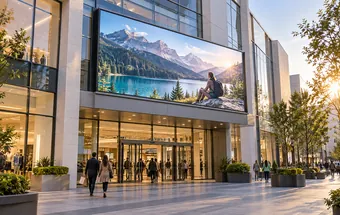
Prevision CF Series transparent LED crystal film turns indoor glass into a video display. The self-adhesive film can be cut to length to fit individual panes, making it easier to cover a frontage with different window sizes. Product displays remain visible behind the screen, and artwork can be divided around the frames.
For example, an 8 × 4.8 m layout uses 160 standard modules in an 8-column, 20-row grid. P4 gives 2,000 × 1,200 pixels; P8 gives 1,000 × 600. P4 fits more image detail into the same frontage, while P8 suits larger graphics and shorter messages.
Send the clear dimensions of each pane, frame positions and daytime photos. Prevision can then specify the cut lengths, finished pixel layout and control equipment for your window display.
Transparent LED Film Configurations
P4 means a 4 mm pixel pitch; P5 means 5 mm. Select the pitch by screen size, viewing distance and how much detail the content needs.

P4 and P5 pack more pixels into the same screen area than wider pitches. They suit closer viewing and help preserve product textures, image edges and small text in window displays.

P4-8 keeps the same horizontal pixel count as P4, with half as many rows. It suits simpler content; fine lettering needs more height to retain its shape.

For brighter street-facing windows, these models offer 3,800–4,000 nits. Use large product images and short headlines; assess them through the installed glass where reflections are strongest before finalising the model.

Choose wider pixel spacing for oversized logos and simple animation across a large frontage. These models leave more open space between pixels, with less detail available for small lettering.
Transparent LED Film For Your Applications
Use the film on indoor glass, with the layout and content planned for each location.
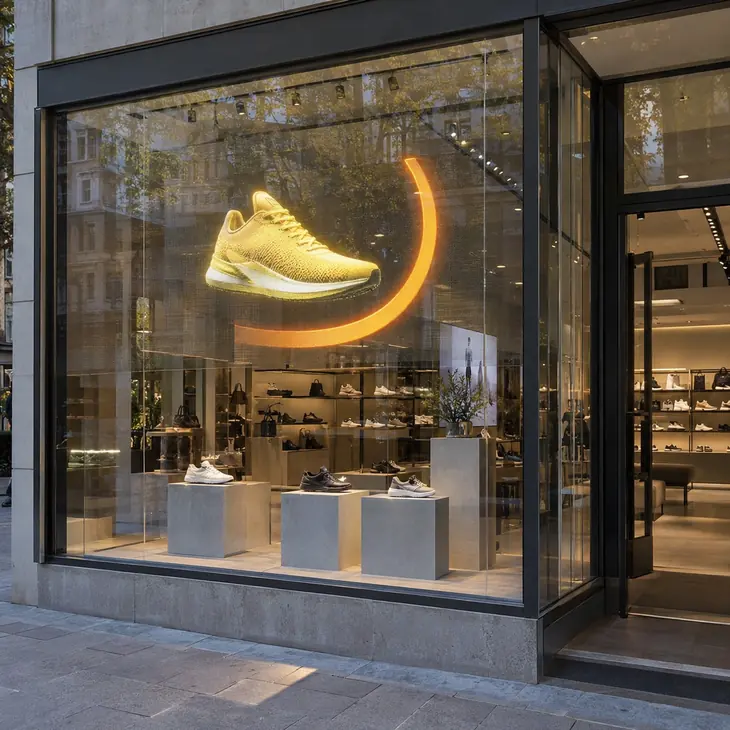
Place a short promotion above the product display and leave part of the screen unlit. Shoppers can read the offer while seeing the merchandise inside, without a printed poster covering the window.
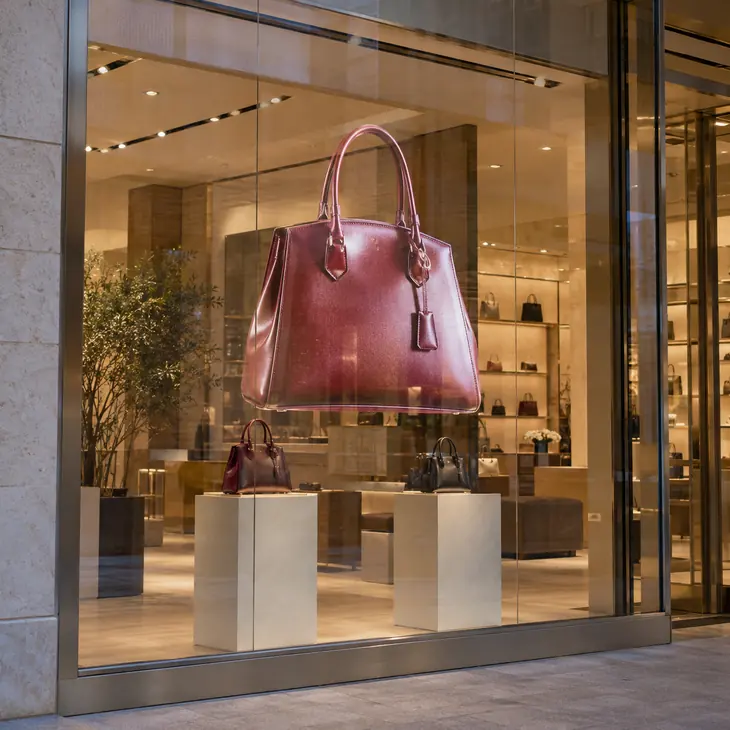
Use product cut-outs on a black video background, with fewer words and larger images. Unlit pixels leave the boutique visible behind the film, so the campaign works alongside the physical window display.

Run vehicle launch graphics across fixed showroom glazing while leaving cars visible inside. Place model names within individual panes so window mullions do not divide the most important part of the message.
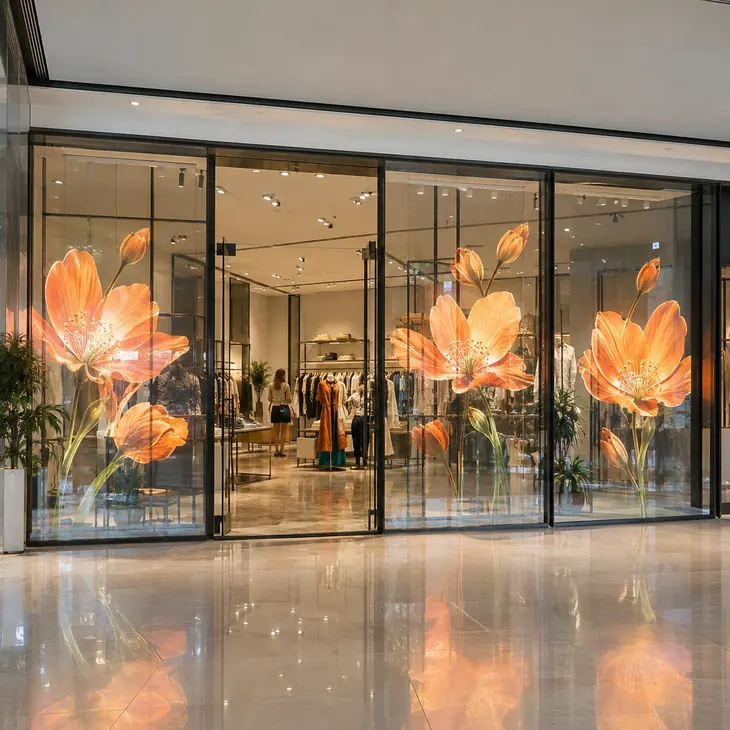
Use several glazed shopfront sections for one seasonal campaign, keeping the store name and offer inside clear glass areas. Supply separate content zones where doorways or frames interrupt the frontage.

For hotel or office lobbies, use fixed glass partitions for a welcome logo, event name or sponsor animation. The transparent surface leaves the space behind it visible to guests and visitors.

Use fixed glass to layer animation over a physical exhibit. Select synchronous control when the film must follow a live demonstration, with the processor specified for the source equipment and screen resolution.
Transparent LED Film Key Advantages

Peel off the protective liner and bond the film to existing glass. No separate hanging frame is needed for the display surface.

At 3 mm thick, the film adds little depth to a window display, leaving more room for merchandise behind the glass.

The film weighs 3 kg/m². Keep power supplies and controllers on separate supports so their weight is not carried by the film.

P4–P8 offers at least 85% transparency, P10/P16 at least 90%, and P20–P40 at least 93%. Merchandise remains visible behind the display.

Trim the film length to match each pane. This accommodates different window widths and reduces unused margins around the display.

The flexible crystal film follows flat and curved glass surfaces. It fits straight shopfronts and rounded glazing without a rigid cabinet surface.
Apply Directly to Existing Glass
Prevision transparent LED film can transform the existing window glass into an advertising screen without the need to replace the glass. The self-adhesive film installation consists of four steps: removing the protective layer, attaching the film, connecting the signal lines and power lines. Each piece of glass is cut into appropriate lengths, and the cables are arranged along the window frame edge. The power and controller are easy to maintain, allowing you to easily install this transparent LED film screen.

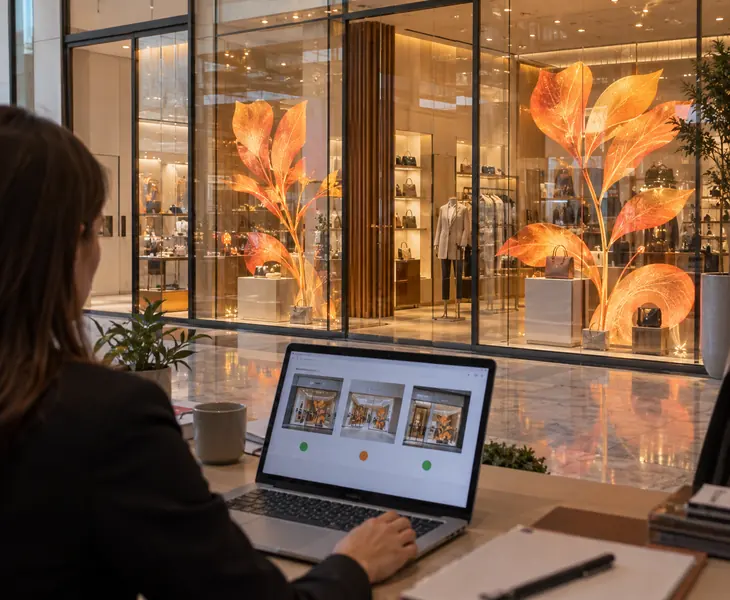
Update Multiple Store Windows Remotely
The team of Prevision will configure the cloud platform so that your transparent LED film can be managed through a computer, tablet or smartphone. Each store is equipped with a network player and cloud connection. The headquarters can uniformly update the advertising activities of multiple windows and view the working status of the display screens at one place. This avoids the cumbersome operation of each store team loading the advertisements separately at each location. Appropriate screen design is prepared for each screen ratio to ensure that the products and logos maintain their original shapes.
Transparent LED Film Installation Case

A premium retail store in Istanbul, Turkey wanted to turn its large street-facing glass window into a digital advertising surface without blocking the view into the store. Prevision configured a P4 Transparent LED Film Display measuring 4.8 × 2.4 meters, with a resolution of 1200 × 600 pixels. The LED film was installed directly on the existing glass, allowing the customer to display product campaigns and promotional videos while keeping the storefront open and visually transparent.

An automotive showroom in Port of Spain, Trinidad and Tobago needed a large digital display for its glass façade. The customer wanted to promote new vehicles and campaigns without blocking natural daylight or reducing visibility into the showroom. Prevision provided a P6 Transparent LED Film Screen measuring 6 × 3 meters, with a resolution of 1000 × 500 pixels. The transparent LED film allows promotional videos and vehicle information to be displayed directly on the existing glass while maintaining an open showroom appearance.

A shopping mall in Johor Bahru, Malaysia wanted to transform a large glass atrium into a digital advertising space without installing a heavy LED cabinet structure or significantly affecting the transparent architectural design. Prevision configured a P8 Transparent LED Film Display measuring 8 × 4 meters, with a resolution of 1000 × 500 pixels. The lightweight LED film uses the existing glass surface to display brand campaigns, shopping promotions, and event content.

A hotel in Buenos Aires, Argentina wanted to display event information, welcome messages, and promotional content on a glass wall in the lobby. The customer needed digital signage but did not want to lose the open visual connection between the lobby and surrounding interior spaces. Prevision configured a P5 Transparent LED Film measuring 5 × 2.5 meters, with a resolution of 1000 × 500 pixels. The display transforms the existing glass wall into a digital communication surface while maintaining the open architectural design.

An exhibition venue in Budapest, Hungary required a digital display for an existing glass partition. Installation space was limited, and the customer wanted to avoid building a deep LED cabinet structure that would reduce usable floor space. Prevision configured a P4 Transparent LED Film Screen measuring 5.12 × 2.64 meters, with a resolution of 1280 × 660 pixels. The thin film display uses the existing glass partition and provides digital content without requiring a conventional freestanding LED wall.
CF Series Transparent LED Film Specifications
- CF Series Models
- Common Specifications
- 8 × 4.8 m Resolution
- Display Comparison
Standard uncut module dimensions: 1,000 × 240 mm (W × H). Pixel pitch is nominal. The pixel grids below apply to uncut modules; sections cut to length need a revised pixel layout.
| Model | Nominal pitch W × H (mm) | Module pixels W × H | Brightness (nits) | Transparency |
|---|---|---|---|---|
| P4 | 4 × 4 | 250 × 60 | 1,500 | ≥85% |
| P4-8 | 4 × 8 | 250 × 30 | 2,500 | ≥85% |
| P5 | 5 × 5 | 200 × 48 | 2,500 | ≥85% |
| P6 | 6 × 6 | 166 × 40 | 3,800 | ≥85% |
| P8 | 8 × 8 | 125 × 30 | 4,000 | ≥85% |
| P10 | 10 × 10 | 100 × 24 | 3,800 | ≥90% |
| P16 | 16 × 16 | 64 × 15 | 3,000 | ≥90% |
| P20 | 20 × 20 | 50 × 12 | 2,500 | ≥93% |
| P30 | 30 × 30 | 34 × 8 | 1,200 | ≥93% |
| P40 | 40 × 40 | 25 × 6 | 1,000 | ≥93% |
P4-8 uses 4 mm horizontal and 8 mm vertical pixel spacing. Transparency values apply to the film; glass tint and coatings also affect the finished window’s appearance.
Common Technical Specifications
The quotation specifies the driving configuration, control equipment and supply voltage for the selected model.
| Parameter | CF Series specification |
|---|---|
| Module dimensions / film thickness | 1,000 × 240 mm (W × H) / 3 mm |
| Film weight | 3 kg/m² |
| Installation / protection | Indoor glass / IP30 |
| LED package | P4: SMD1313; other listed models: SMD2121 |
| Refresh rate | 1,920 or 3,840 Hz; confirm configuration |
| Processing / grayscale | 14/16 bit; 16,384/65,536 levels |
| Viewing angle | 140° horizontal / 140° vertical |
| Brightness adjustment | Levels 0–255 |
| Colour temperature | 3,200–8,500 K, adjustable |
| Power per square metre | 600 W maximum; 200 W listed working power* |
| Standard input | AC 220 V ±10%, 50–60 Hz; other supplies by confirmation |
| Control mode | Synchronous / asynchronous |
| Operating temperature | −20 to +50 °C |
*The datasheet lists working power at 200 W/m². Actual consumption depends on the content and brightness setting.
Resolution for an 8 × 4.8 m LED Film Display
Calculated layout: 8 columns × 20 rows = 160 standard modules, covering 38.4 m². Multiply each module’s pixel width by 8 and pixel height by 20. Dimensions exclude window frames, gaps and installation clearances.
| Model | Screen pixels W × H | Content examples |
|---|---|---|
| P4 | 2,000 × 1,200 | Product photographs and campaign text |
| P4-8 | 2,000 × 600 | Wide graphics with fewer lines of text |
| P5 | 1,600 × 960 | Product images, logos and short descriptions |
| P6 | 1,328 × 800 | Campaign video with large captions |
| P8 | 1,000 × 600 | Large product images and short headlines |
| P10 | 800 × 480 | Brand graphics and brief promotional messages |
| P16 | 512 × 300 | Large logos and simple animation |
| P20 | 400 × 240 | Bold lettering and graphic shapes |
| P30 | 272 × 160 | Large symbols and moving colour |
| P40 | 200 × 120 | Simple logos and colour effects |
This is a layout example, not a maximum screen size. Final dimensions follow the glazing and approved module arrangement. Test the intended artwork from the viewing position; P4-8 needs content mapping for rectangular pixel spacing.
LED Film, Transparent Cabinets or an Opaque Screen?
| Decision | CF adhesive LED film | Transparent LED cabinets | Opaque LED / LCD |
|---|---|---|---|
| View through the display | See-through film; model-dependent transparency | Open LED structure; varies by model | Blocks the view behind the screen |
| Mounting | Bonds to suitable glass; hardware housed separately | Needs a supporting or hanging structure | Wall, floor stand or supporting frame |
| Changing locations | Plan as a fixed glass installation | Rental models available for repeat assembly | Depends on screen and mounting system |
| Detailed content | Check physical pixels and background visibility | Check pitch and native resolution | Opaque background better separates text from surroundings |
| Typical reason to choose | Add window video while preserving a view inside | Use transparent screens where adhesive film is unsuitable | Prioritise detailed information over transparency |
Cabinet and opaque-screen characteristics depend on the selected model. Film is the option here for bonding a display directly to suitable indoor glazing.
Customer Feedback
The Transparent LED Film lets us run digital promotions directly on the storefront glass without blocking the view into the store. The finished installation looks clean and modern.
Emre YıldızThe Transparent LED Film Screen gives us a large advertising area while keeping the showroom bright and open. Customers can still clearly see the vehicles behind the glass.
Andre BaptisteThe Transparent LED Film Display allowed us to use the atrium glass for digital advertising without adding a bulky LED structure. It fits the architecture very well.
Farid IskandarThe Transparent LED Film gives us an easy way to show events, welcome messages, and promotions while keeping the lobby’s glass wall open and transparent.
Lucía FernándezThe LED Film Screen solved our limited installation-space problem. We could use the existing glass partition without building a deep conventional LED wall.
Bálint Kovács
Choose P4 or P5 when shoppers stand near the window and need to see product detail or lettering. Use P8–P10 for larger graphics viewed farther away, and P16–P40 for distant logos. For the same screen size, P4 contains four times as many pixels as P8. Dense text at arm’s length is better served by an opaque fine-pitch display.
Install CF film on the indoor face of the glass. Its IP30 rating provides no water protection, so it is unsuitable for exposed facades or rain-facing installation. For an outdoor display, choose an outdoor-rated transparent LED system. A screen facing the street from inside a dry shop window is an indoor installation.
P8 is the brightest listed CF model at 4,000 nits. Choose P6 at 3,800 nits when finer image detail matters, or P10 at 3,800 nits when higher transparency is the priority: P10 offers at least 90%, versus at least 85% for P6 and P8. With direct sun or dark tinted glass, test a sample through that glass before ordering.
Yes. The standard sheet is 1,000 × 240 mm, and its length can be trimmed to fit the pane. Cutting reduces the pixel count along that edge, so the controller must use the revised pixel layout. Prevision plans the cut lengths and module positions pane by pane, keeping text and logos clear of window frames.
No, if you use an asynchronous player. It stores advertisements locally and plays them without a permanent computer or internet connection. Internet access is needed for cloud updates. Use synchronous control for a live computer or camera feed. A computer, tablet or phone can manage content through the compatible control system.
Yes. A faulty film section can be replaced while working sections remain installed. For a dark panel, have the installer check its power and signal connections before removing the film. Keep spare sections with the same pixel pitch and cut dimensions. Prevision can help identify the affected component from fault photos and the screen layout.
Prepare artwork for the screen’s native pixel layout. In the 8 × 4.8 m P4 example, the canvas is 2,000 × 1,200 pixels. Use large product cut-outs and short headlines on a black background; black pixels remain unlit, preserving the view through the film. Keep logos within individual panes so window frames do not divide them.
Prevision provides a three-year warranty. The CF specification lists a rated display life of 100,000 hours; this does not mean every power supply or controller will run that long without servicing. For warranty support, provide the order number, fault photos and the affected section’s position. The order should state parts coverage, repair arrangements and freight responsibility.
Include film modules, power supplies, control hardware, cables and spare parts. For an uncut 8 × 4.8 m P4 screen, specify 160 modules and a controller supporting 2,000 × 1,200 pixels: 2.4 million pixels in total. Check its width, height and output-port limits as well as total capacity. List software, cloud service, shipping and installation charges separately.
Related Products
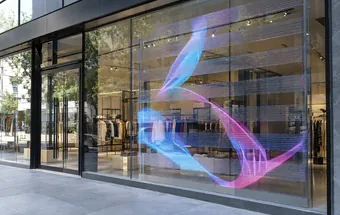
Compare film with cabinet-based transparent screens for different mounting and maintenance requirements.
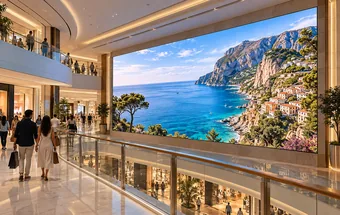
Choose an opaque display when detailed text matters more than visibility through the window.
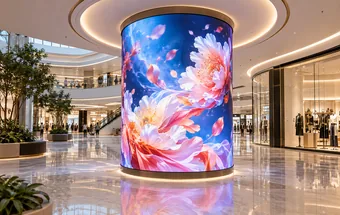
Cover interior columns and curved features where an opaque LED surface is required.
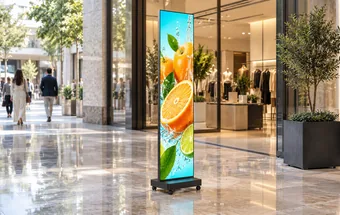
Use a freestanding screen for entrance promotions without bonding a display to glass.
Specify a weather-rated display for exposed facades and signs outside the glazing.